




Op. Dr. Mecd Atıf Cezairlioğlu Op. Dr. Mecd Atıf Cezairlioğlu
Op. Dr. Mecd Atıf Cezairlioğlu
Answers to Every Step of the Journey — On the Blog
Make an appointment
The Right Choice in Breast Revision Surgery: Under or Over the Muscle?
Learn when moving a breast implant from above the muscle to a below-the-muscle or Dual Plane position may be considered for breast sagging, implant displacement and loss of upper-pole fullness. Discover my approach to implant

Breast Implant Revision from Above the Muscle to Below the Muscle

Breast augmentation can provide long-lasting and satisfying results when the implant size, placement and surgical technique are carefully planned. However, the appearance of the breasts can change over time. Aging, pregnancy, breastfeeding, weight fluctuations, loss of skin elasticity and the use of relatively large implants can all contribute to changes in breast shape.

This can be particularly noticeable in patients who previously had breast implants placed above the muscle.

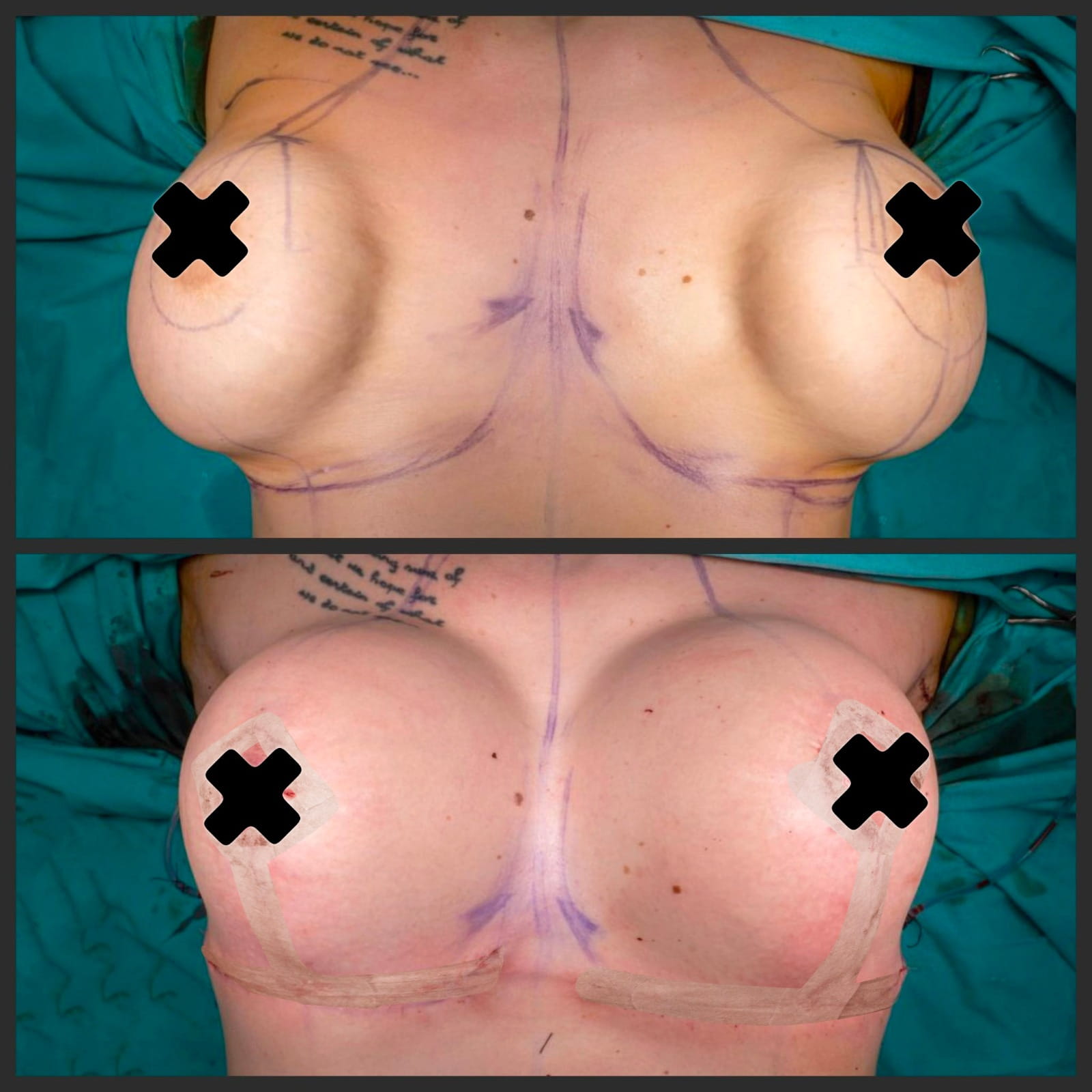
Over time, the weight of the implant combined with the natural changes in the breast tissue can contribute to breast sagging, downward displacement of the implant and loss of upper-pole fullness. In some patients, simply replacing the existing implant with a new one may not provide the long-term support or shape that is desired.

In carefully selected patients, moving the implant from above the muscle to a below-the-muscle or dual plane position may provide a more controlled approach to breast revision.

My approach to this type of revision is not simply to remove the old implant and place a new implant behind the muscle. The goal is to reconsider the entire breast structure: the implant pocket, the surrounding soft tissues, the implant size and the way the breast tissue supports the implant.

Why Can an Implant Above the Muscle Contribute to Breast Sagging?

With an implant placed above the muscle, the implant sits directly behind the breast tissue. This can provide excellent results in appropriately selected patients, particularly when there is sufficient natural breast tissue to provide adequate soft-tissue coverage.

However, the breast changes over time.

The implant itself has weight, and that weight is continuously supported by the surrounding breast tissue and skin. If the skin and soft tissues gradually lose elasticity, the breast may become more stretched and begin to descend.

This process can be influenced by several factors, including:

  • Implant size and weight

  • Skin elasticity

  • The amount and quality of natural breast tissue

  • Aging

  • Pregnancy and breastfeeding

  • Significant weight fluctuations

  • The degree of pre-existing breast laxity

The issue can become more significant when relatively large implants are used in tissues that already have limited capacity to provide long-term support.

For this reason, in some patients who have previously undergone breast augmentation with an implant above the muscle and later developed breast sagging, changing the implant position may be worth considering.

What Does Moving a Breast Implant from Above the Muscle to Below the Muscle Mean?

Moving an implant from above the muscle to below the muscle is not simply a matter of taking the implant out and putting another one behind the pectoral muscle.

A previous breast augmentation changes the anatomy of the breast. The old implant pocket has already been created, the surrounding tissues may have stretched and the breast tissue may have adapted to the previous implant.

Therefore, revision surgery requires careful management of both the old pocket and the new implant pocket.

In appropriate patients, I create a new dual plane pocket. This allows the implant to receive muscular coverage while also allowing the breast tissue to be reshaped over the implant.

The purpose is not simply to place the implant behind the muscle. It is to create a controlled environment in which the implant can be positioned appropriately and the surrounding breast tissue can be managed at the same time.

Creating a New Dual Plane Pocket During Revision

One of the most important steps in moving an implant from above the muscle to a dual plane position is the creation of the new implant pocket.

When the previous implant is removed, the old pocket remains an important part of the revision anatomy. Simply leaving this previous space uncontrolled may create unnecessary room around the new implant.

In my revision technique, I create a new dual plane pocket behind the muscle when appropriate. I then use my own surgical approach to close and control the previous above-the-muscle implant pocket as much as possible.

One of my goals is to minimize unnecessary dead space between the old and new pocket.

This is particularly important in revision breast surgery because the anatomy is no longer the same as it was during the first operation. Previous surgery may have stretched the tissues and created a pocket that no longer corresponds to the ideal position for the new implant.

Therefore, revision surgery is not only about deciding where the new implant should go. It is equally important to decide what should be done with the previous implant pocket.

Using Fascial Tissue as an “Internal Bra”

Another important part of my approach is making use of the patient's own tissues whenever possible.

When tissue needs to be removed or reshaped during revision surgery, I may use the available fascial tissue as part of the support structure around the implant.

For patients, I often describe this concept as an “internal bra.”

The concept is relatively straightforward: an external bra supports the breast from underneath, while an internal support structure uses the patient's own tissues to provide additional support to the lower portion of the breast and around the implant.

Of course, this is not literally the same as wearing a bra, and the technique cannot be applied identically to every patient. The amount and quality of available tissue, previous surgeries and the anatomy encountered during revision all determine whether this approach is appropriate.

When suitable, however, using the patient's own fascial and soft-tissue structures can help create a more controlled environment around the implant and support the reshaped breast.

Why Is a Larger Implant Not Always Better?

One of the most important considerations in breast implant revision is implant size.

Patients who have experienced breast sagging after a previous augmentation may understandably think that a larger implant will restore fullness and improve the appearance of the breast.

While a larger implant can provide more volume, it also has greater weight.

If the existing breast tissue and skin are already stretched or weakened, increasing the implant size may place additional load on those tissues. It may create an attractive appearance initially, but excessive implant volume may not always be the best strategy for long-term stability.

My approach is therefore not to choose the largest possible implant.

Instead, I aim to select an implant that provides adequate fullness while remaining appropriate for the patient's body proportions and the capacity of the surrounding tissues.

The ideal implant is often the one that provides a full, proportionate and attractive breast without unnecessarily exceeding the capacity of the soft tissues.

In revision surgery, finding the right implant size can be more important than simply increasing the volume.

Which Patients May Benefit from Moving the Implant Below the Muscle?

Not every patient with an implant above the muscle needs to have the implant moved behind the muscle.

I particularly consider this approach when several issues are present together, such as:

  • A previous breast implant placed above the muscle

  • Progressive breast sagging

  • Downward displacement of the implant

  • Loss of upper-pole fullness

  • Loose or stretched breast tissue

  • Insufficient soft-tissue support around the implant

  • An implant that may be relatively large or heavy for the patient's tissues

  • A previous implant pocket that requires significant revision

Depending on the individual anatomy, additional procedures such as a breast lift, pocket revision or implant replacement may also need to be considered.

The decision should therefore never be based solely on the implant's current position.

The quality of the breast tissue, skin elasticity, degree of sagging, previous surgery, implant dimensions and the patient's aesthetic goals all need to be evaluated together.

What Determines the Success of Breast Implant Revision?

Successful breast implant revision depends on much more than changing the implant position.

1. Careful Surgical Planning

The existing implant position, old pocket, breast tissue quality, skin elasticity and degree of breast ptosis must all be assessed before surgery.

Every patient has a different anatomy, and the same revision technique cannot be applied in exactly the same way to everyone.

2. Choosing the Right Implant

Implant selection involves more than volume.

The implant's base width, projection and overall dimensions should be compatible with the patient's chest and breast tissue.

My goal is not simply to make the breast larger. It is to achieve the appropriate amount of fullness while maintaining balance and respecting the capacity of the surrounding tissues.

3. Creating the New Implant Pocket Correctly

When a dual plane approach is appropriate, the new pocket needs to be carefully designed and positioned.

The goal is to establish a stable environment for the implant and reduce the risk of unwanted implant movement.

4. Controlling the Previous Pocket

The old above-the-muscle pocket should not simply be ignored.

When appropriate, controlling or closing this previous space can help reduce unnecessary dead space and improve control over the position of the new implant.

5. Supporting the Implant With Soft Tissue

The implant should not be considered independently from the tissues surrounding it.

When possible and appropriate, the patient's own fascial and soft-tissue structures can be incorporated into the revision strategy to provide additional support.

6. Choosing the Right Implant Size

One of the most important factors in achieving a durable result is finding the balance between fullness and tissue capacity.

The goal is to create a breast that looks full without placing unnecessary weight on already stretched tissues.

7. Understanding the Patient's Expectations

Revision breast surgery is not simply about making the breasts larger.

The position of the breast, upper-pole fullness, nipple position, breast proportions and long-term tissue behavior should all be considered.

Does Moving the Implant Below the Muscle Prevent Future Sagging?

No surgical technique can guarantee that the breast will never sag again.

Breast tissue continues to change throughout life. Aging, pregnancy, breastfeeding, changes in body weight and natural changes in skin elasticity can all affect the breast.

Moving an implant behind the muscle or using a dual plane approach may provide additional support and a more controlled configuration in appropriately selected patients, but it should not be presented as a guarantee against future breast sagging.

This is why long-term tissue behavior needs to be considered when planning revision surgery.

My Approach to Breast Implant Revision

I do not consider revision from above the muscle to below the muscle to be simply an implant exchange.

The aim is to address several factors simultaneously:

supporting the implant, maintaining an attractive and full breast shape, controlling the previous implant pocket and creating a breast configuration that can remain stable for as long as possible.

When appropriate, I create a new dual plane pocket, control the previous above-the-muscle pocket and use available fascial and soft-tissue structures to help support the implant.

In patients who previously had relatively large implants and subsequently developed breast tissue laxity or sagging, I believe it is particularly important to avoid solving the problem simply by placing an even larger implant.

Instead, I focus on finding the right balance between implant volume and the ability of the surrounding tissues to support it.

For me, the ideal result is not the largest possible breast.

It is a full, proportionate and well-supported breast created with an implant size that fits the patient's anatomy without unnecessarily overloading the surrounding tissues.

Conclusion

Patients who have previously undergone breast augmentation or breast augmentation with a lift may experience changes in breast shape over time. Sagging, downward implant displacement and loss of upper-pole fullness can occur as the breast tissue and skin naturally change.

In appropriately selected patients, moving a breast implant from above the muscle to a below-the-muscle or dual plane position may be an effective component of revision surgery.

However, the decision should not be based solely on the implant's current position.

The quality of the breast tissue, skin elasticity, degree of sagging, previous surgery, implant dimensions and the patient's expectations all need to be considered during surgical planning.

My approach is not simply to remove the old implant and place a new one behind the muscle. I aim to create a new implant pocket, control the previous pocket, use the patient's own tissues when appropriate and select an implant size that provides adequate fullness without unnecessarily exceeding the supporting capacity of the breast tissues.

For patients who have developed sagging after an above-the-muscle breast implant, this comprehensive revision approach can help create a more balanced, supported and controlled breast shape.

Op. Dr. Mecd Atıf Cezairlioğlu
It can respond in about 1 hour.
Op. Dr. Mecd Atıf Cezairlioğlu
Hello, how can I help you?
16:41
At Dr. Atıf Cezairlioğlu, we use cookies on our website. This Cookie Policy (“Policy”) applies to the website managed by Dr. Atıf Cezairlioğlu at https://doctoratif.com/ and explains how cookies are used in accordance with this Policy.

I accept